Friday, July 11, 2014

Money Essentials on Buying a House

Money Essentials on Buying a House

1. Can't stay put? Don't buy!
If you can't commit to remaining in one place for at least a few years, then owning is probably not for you, at least not yet. With the transaction costs of buying and selling a home, you may end up losing money if you sell any sooner - even in a rising market. When prices are falling, it's an even worse proposition.
2. Shape up your credit
Since you most likely will need to get a mortgage to buy a house, you must make sure your credit history is as clean as possible. A few months before you start house hunting, get copies of your credit report. Make sure the facts are correct, and fix any problems you discover.
3. Buy within your means
The rule of thumb is that you can buy housing that runs about two-and-one-half times your annual salary. But you'll do better to use one of many calculators available online to get a better handle on how your income, debts, and expenses affect what you can afford.
4. Less than 20%
There are a variety of public and private lenders who, if you qualify, offer low-interest mortgages that require a small down payment.
5. The right school district makes all the difference
In most areas, this advice applies even if you don't have school-age children. Reason: When it comes time to sell, you'll learn that strong school districts are a top priority for many home buyers, thus helping to boost property values.
6. Get professional help.
Even though the Internet gives buyers unprecedented access to home listings, most new buyers (and many more experienced ones) are better off using a professional agent. Look for an exclusive buyer agent, if possible, who will have your interests at heart and can help you with strategies during the bidding process.
7. Choose your points wisely
When picking a mortgage, you usually have the option of paying additional points -- a portion of the interest that you pay at closing -- in exchange for a lower interest rate. If you stay in the house for a long time -- say three to five years or more -- it's usually a better deal to take the points. The lower interest rate will save you more in the long run.
8. Get your money right
Getting pre-approved will you save yourself the grief of looking at houses you can't afford and put you in a better position to make a serious offer when you do find the right house. Not to be confused with pre-qualification, which is based on a cursory review of your finances, pre-approval from a lender is based on your actual income, debt and credit history.
9. Do your homework
Your opening bid should be based on the sales trend of similar homes in the neighborhood. So before making it, consider sales of similar homes in the last three months. If homes have recently sold at 5 percent less than the asking price, you should make a bid that's about eight to 10 percent lower than what the seller is asking.
10. Hire a pro inspector
Sure, your lender will require a home appraisal anyway. But that's just the bank's way of determining whether the house is worth the price you've agreed to pay. Separately, you should hire your own home inspector, preferably an engineer with experience in doing home surveys in the area where you are buying. His or her job will be to point out potential problems that could require costly repairs down the road.

Wednesday, July 9, 2014

Moving Tips That Will Make Your Life So Much Easier: Moving in Day

  • Be at your new home before the movers. You may be charged for waiting if you are late.
  • Contact utility companies to verify service start dates.
  • Check the appliances, furnace and hot-water heater. Contact a repair service if something is not working.
  • Place a floor plan of your new home by the entrance, so the movers know where to place each piece of furniture.
  • Check the condition of each box or household item as it is unloaded. Make a list of all missing or damaged items on the mover's copy of the inventory form. Since you will do most of the unpacking after the movers leave, it is a good idea to make a "subject to inspection for loss or concealed damage" note on the inventory form. By signing the inventory sheet, you are acknowledging receipt of all items listed. Personally report any loss or damage to your salesperson or move coordinator.
  • To prevent possible damage, television sets, other electronic equipment and major appliances should not be used before they have a chance to adjust to room temperature.
  • Call Canada Post to find out if they are   holding any mail for you and ask the services to start.
moving in day

Tuesday, July 8, 2014

How To Buy Your First Home

Make sure buying is for you. Are rents cheap and homes costly in your city? Are you planning to move in the next year or two? Is your job looking iffy? If any of these apply, buying might not be a good move. After all, the days when houses could quickly be flipped for more money are history.
“Real estate is not as liquid an investment as it was 5 or 10 years ago,” cautions Steve Domber, president of Prudential Serls Prime Properties, a real estate broker firm operating across New York state and Connecticut. “If you don’t feel that you are going to stay in your job in your current location then consider renting.”

Do a credit check. Cash and good credit are critical to snagging a bargain home and keeping it. Before you go shopping make sure you have the cash on hand for a down payment and a mortgage lender who is willing to provide you with a home loan at an affordable rate.
Get pre-approved by a lender or mortgage brokers. Pre-approval can help expedite the closing of your purchase, a process that given the current economic climate can take months.
Consider a down payment and the alternatives. Another key financial factor is a down payment. Firoved urges real estate newcomers to cough up 20%, which immediately adds equity to your house and lowers monthly payments.

“You know you can afford to buy a home when you have saved enough money to put a down payment,” he says. That down payment also means you can qualify for a loan modification program down the road if, heaven forbid, you need it.
Many first-timers don’t have the cash to put up 20% of a home’s value. No need to worry, says Robert Walters, chief economist and vice president of the Capital Markets Group for Quicken Loans. Your mortgage officer should be able to find alternatives that work for you.
Uncle Sam offers a handful of government-backed loans with 0% to 3.5% down. Check out the Federal Housing Administration’s loans. Former military members can go through the Department of Veterans Affairs, and the Department of Agriculture offers loans through the Rural Development program.
Skirting the traditional 20% down payment means a mandatory additional expense: private mortgage insurance. PMI might not seem like a big deal, but it comes with a few hitches. This insurance typically costs between 0.5% to 1% of the entire loan amount on an annual basis. In other words, a $150,000 loan at a 1% insurance rate adds an extra $125 per month to your bills. The insurance protects your lender against the possibility of you defaulting on the property and can be charged until as much as 50% of the loan is paid off. The good news is PMI is tax deductible for married couples jointly making up to $110,000.
How To Buy Your First Home


Be realistic about costs. However much you make, don’t shop for a home that will gobble up most of your income each month. In addition to mortgage and principal payments, buying a home means paying for insurance, maintenance and real estate taxes.
“One of the biggest mistakes first-time home buyers make is they don’t leave themselves with enough money,” cautions Walters.
Don’t cut corners on inspections. Always cough up the extra cash for a good home inspection, especially if you’re buying a foreclosed home.
“A home inspection is key…to really understanding the condition a home is in,” stresses Domber.
Follow these steps and you could be in a place of your own that provides happy, lucrative returns for years to come. Says Walters: “I think that 20, 30, 40 years from now we’ll see that this was potentially one of the best times in modern history for a first-time home buyer to purchase a home.”

Monday, July 7, 2014

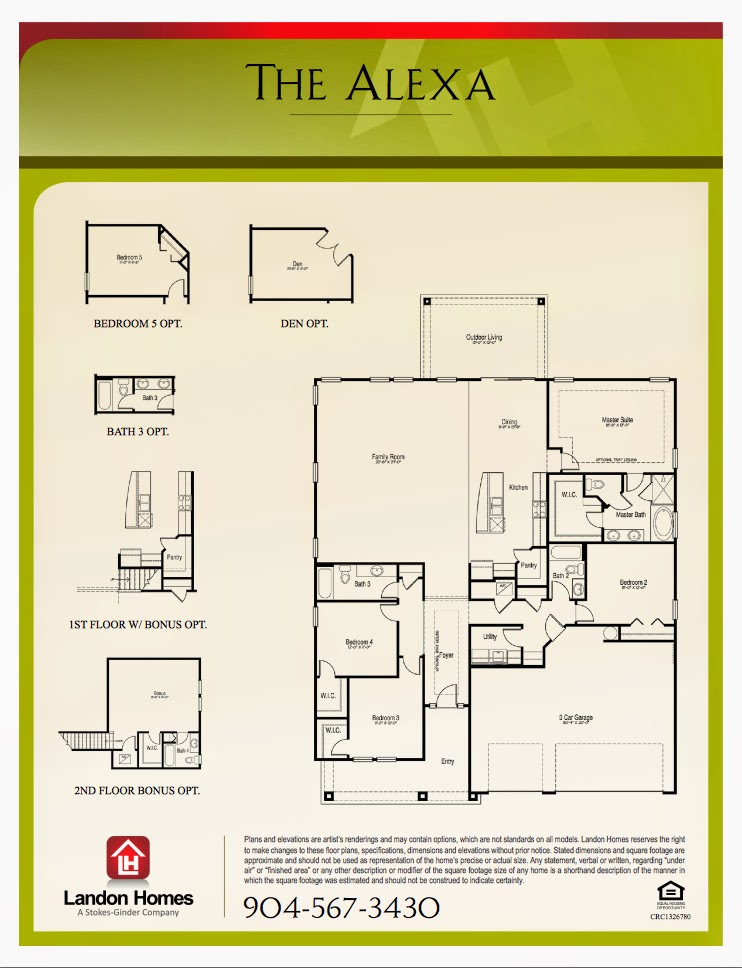
Featuring the Alexa Floor Plan, Benton Lakes is building NOW!


Benton Lakes, one of Jacksonville's most desired neighborhoods nestled in charming Mandarin. We feature a variety of unique home designs on large homesites. With its convenient location in Mandarin, located off of Hood Road, Benton Lakes is close to all Mandarin has to offer. Benton Lakes is just minutes from I-95 and I-295, and allows for quick access to downtown Jacksonville, Historic St Augustine, and many of the city's top business centers. With the Avenues Mall, and St Johns Town Center just around the corner, shopping, dining and entertainment are endless.

Maple Lakes Drive
City: Jacksonville, FL 32226Price Range: From the $260'sContact: Susan Penta
County: DuvalSQ Ft Range: 2050-3551Ph: 904-868-8986 Get Started Today

Alexa Floor Plan, Benton Lakes, Jacksonville new build homes, Landon Homes


Alexa Floor Plan, Benton Lakes, Jacksonville new build homes, Landon Homes

Alexa Floor Plan, Benton Lakes, Jacksonville new build homes, Landon Homes


Thursday, July 3, 2014

Promoting the American Dream of Homeownership

Promoting American Dream

I joined President Obama in visiting Phoenix, where he laid out his vision for a housing system that promotes the American dream of homeownership. 
For years, owning a home was a symbol of responsibility and a source of security for millions of middle-class families across the country. But the financial crisis in 2008 put that all at risk, and by the time President Obama took office, the housing market was in free fall. Home values were plummeting and foreclosures were at record highs.
This Administration immediately took a number of steps to heal the market that helped millions of Americans stay in their homes, save money on their mortgages and turn their communities around.
Today, the market is coming back. Thanks to reforms of the financial system that cracked down on the most reckless practices that led to the housing crisis, responsible Americans can feel more confident and secure when they borrow money to purchase their own home. 
President Barack Obama and Housing and Urban Development Secretary Shaun Donovan tour Erickson Construction
President Barack Obama and Housing and Urban Development Secretary Shaun Donovan tour Erickson Construction, a housing construction company, in Chandler, Ariz., Aug. 6, 2013. (Official White House Photo by Pete Souza)
But, as President Obama made clear today, there is more work to do. It’s time to turn the page on an era of housing bubbles and taxpayer bailouts, and build a new housing finance system that will provide secure homeownership for responsible middle class families.
We see this as critically important, not only because housing and home ownership are one of the bedrock cornerstones of the middle class – but also because it is so connected to the other ones.  How do most families pay for their kids to go to college, to start small businesses, to save for retirement? It's through the savings in their homes.  If we can't protect American families from this kind of crisis again, if we can't build safe, stable investment in housing and home ownership, we also cut out the rungs in the ladder to opportunity for so many families in other areas as well. 
First, there are steps we can take right now that could help immediately strengthen the housing market and make sure that no homeowners or communities are left behind by the housing recovery. This includes helping more responsible homeowners save money by refinancing their mortgages, cutting red tape so responsible families can get a mortgage, helping hard-hit communities rebuild, and preserving access to affordable rental housing
Second, President Obama put forward a plan to reform the housing finance system, centered on four core principles:
  • Put private capital at the center of the housing finance system.
  • End Fannie Mae and Freddie Mac’s failed business model so taxpayers are never again on the hook for bad loans and bailouts.
  • Ensure widespread access to safe and responsible mortgages like the 30-year fixed rate mortgage in good and bad economic times.
  • Support affordability and access to homeownership for creditworthy first-time buyers and access to affordable rental housing for middle class families and those aspiring to be. 
Third, because buying a home is one of the most important decisions middle-class families make, there is more we can do to make sure that process is safe, sustainable and easy to understand. The Consumer Financial Protection Bureau has already taken a number of steps to this end, and President Obama is calling on the CFPB to finish a simplified mortgage disclosure form, which highlights the key facts any potential homeowner should know before they take out a mortgage in three pages or less.
Finally, Congress must move quickly to confirm Mel Watt, President Obama’s pick for Director of the Federal Housing Finance Agency, to transition toward a safe and sound future housing finance system.  
By taking these and other steps outlined in the President’s plan, we can finally put an end to the practices that got our country into this mess. As a result, we will grow our economy and give the middle class – and all those working hard to get there – a better bargain for generations to come. 
Shaun Donovan is the Secretary of Housing and Urban Development

Wednesday, July 2, 2014

How to Finance Your New Home

Finance Your New Home
What you need to know -- and do -- to make the mortgage process smooth.
When shopping for a new home, visions of gorgeous kitchens, sumptuous master baths and closet space galore may dance in your head, but you can't forget the important step called financing.
As you shop for your dream home, key questions to ask yourself very early in your search include:
    • Are my credit reports accurate, up-to-date and correct? 
    • What information will I need to gather to apply to finance my new home? 
    • What can I afford in the way of a mortgage? 
    • What are my loan options? 
    • Where do I learn more about, and ultimately shop for, a mortgage?
    In many respects, financing a new home is much like getting a mortgage to purchase a resale home -- but there's an important difference. When buying resale, you shop around for rates and terms from banks, mortgage companies, brokers and online lenders. You can do the same when buying a new home, but there's often an additional resource. Your builder may offer attractive financing packages, either directly through its own mortgage subsidiary or via an affiliate.
    In addition to builder financing, there are some unique tools that apply to new homes (but not to resale homes) that include bridge loans and construction financing. These can be used to fund the purchase and construction of a new home before the sale of your current home.
    We'll look at each topic in detail, but first there are important steps you'll need to take to ensure you have all the information, documentation and forms that you'll need.
    GETTING READY  
    Someone once said success happens when preparation meets opportunity. Whatever lender or type of financing you ultimately select, it's vital that you start preparing well in advance of application. Here are some key steps to make the process simple and efficient:
    Obtain Your Credit Information: Well in advance of home shopping, you need to order your national credit files -- ideally from all three credit bureaus (Equifax, Experian, Trans Union). Make sure there are no inaccuracies or outdated information. You can get your files free once a year at www.annualcreditreport.com. Correct anything you find in error upfront; otherwise you'll delay the entire financing process. Also order your FICO credit scores from one or more of the bureaus. They'll play a key role in determining what sort of terms your lender will offer.
    Gather Key Documents: Any lender will need to see documentation of your income, employment, two years of IRS filings if you are self-employed, bank accounts, 401(K) funds and other assets. It's smart to compile this before you even begin shopping for financing options. It's also useful to have at least a rough idea of your current household expenses; they will affect the amount of mortgage you can obtain and the maximum price of the house you can finance.
    Determine How Much You Can Afford: You can get a good idea about this well in advance of shopping by checking calculators that most lenders and builders provide on their websites. Simple rules of thumb (such as, you can afford a home two to two-and-a-half times your gross annual income) were cited in the past. However, today's rules are much more complex. Most lenders take your basic information and enter it into automated underwriting models that blend credit scores, debt-to-income ratios and other factors to make decisions about loan sizes, rates and fees,
    The bottom line is: get accustomed to experimenting with different rates, down payment amounts, loan terms (30-year, 15-year, fixed-rate, adjustable-rate) to see how your maximum mortgage amount varies and how that affects the top price you can afford for a new house.
    THE MANY SHADES OF LOANS
    Mortgage loans come in different shapes and sizes. Think of them in terms of their problem solving characteristics:
    FHA Loans: If you've got only minimal cash to make a down payment and your credit history has a few blemishes, a federal government-backed loan is most likely your best choice. FHA (Federal Housing Administration) loans allow down payments as low as 3.5% along with generous credit underwriting.
    VA Loans: VA loans require no down payment, but you must be a veteran to qualify. USDA rural loans also allow zero down, but they're limited to areas with relatively small populations and may have income restrictions. The caveats are the FHA has been increasing its insurance fees recently, which increases your monthly payments. The VA has increased its guarantee fee, as well.
    Conventional Loans: If you have more than 10% or 20% to put down, these may be your best bet. Conventional loans are designed to be sold to Fannie Mae and Freddie Mac (the government-chartered mega-investors). The downside is conventional underwriting rules are more strict and banks may impose add-on fees to loans, increasing your cost. Down payments below 10% may be possible but they require high private mortgage insurance premiums.
    CONSTRUCTION LOAN FINANCING
    A construction loan is likely to be useful to you if you are building a home yourself as general contractor or working with a custom builder. Most construction loans provide short-term funds designed to get you through the building stage of your project (six to 12 months) followed by a conversion into a permanent long-term loan of 30 or 15 years. Some key features to be aware of in advance include:
    Sources: Construction loans are a specialized niche in the lending industry and nowhere near as widely available as standard mortgages. Your best bet is to shop among community banks that know the local or regional marketplace, especially savings banks and thrift institutions, though some brokers advertise online and are worth checking out.
    Draws: You can expect an installment schedule of drawdowns of funds in any loan contract. Though always negotiable, a typical schedule might provide for an initial draw of 15% of the full loan amount for the site preparation and foundation stage; a second draw of another 15% to 20% for the framing, and additional draws over the remaining months for the work on plumbing, electrical system, interior carpentry, installation of appliances, etc. Before each draw is paid out, the bank will send an inspector to the site to report on the progress of the work and to determine whether it meets local building codes and regulations.
    Down Payments: Most banks who offer construction financing want to see substantial down payments upfront -- typically at least 20% to 25%. However, some lenders have specialized programs which link FHA-insured permanent loans with short-term construction loans. So say you plan to build a house that is expected to be valued at $400,000 at completion on a piece of land you already own. A local commercial bank might offer you a nine-month, $300,000 loan to construct the house -- figuring $100,000 as the land value -- and ask for an $80,000 (20%) down payment based on the projected appraisal at completion. At the end of the construction period, you'd end up with a $300,000 permanent loan.
    Interest Rates: Generally the short-term, construction-period segment of the financing package will carry a "prime-plus" interest rate. If the prime short-term bank lending rate is 3 percent, the construction period loan might be set at 4-1/4% to 4-1/2%. The permanent 30-year or 15-year portion of the package generally will be near the going rate for regular mortgages -- say 4-1/4% to 4-1/2% on a fixed 30-year loan. Rates can be significantly lower for adjustable rate options such as a popular "5/1" ARM where the rate is fixed for the first five years of the loan, but can vary each year thereafter, typically within a pre-specified range.
    BRIDGE FINANCING  
    So-called "bridge" loans can also be important tools for you. These short-term (six to nine months) financings are designed to get you past a timing squeeze, such as when you're buying a new home but haven't yet sold your current house and don't have all the cash you need.
    The lender, who may be a local bank or a subsidiary of your builder, agrees to advance you money using the equity you've got in your current home as collateral.
    Say you're short by $50,000 on a down payment needed to buy your new house. Your current home is for sale, but you don't yet have a buyer. However, you do have $250,000 in net home equity in your current home and only a small first mortgage. A lender could advance you the $50,000 you need either by placing a second mortgage on your current home or by paying off the existing mortgage and taking a first lien position, well-secured by your remaining equity. Once your house sells, part of the proceeds pay off the bridge loan.
    Keep in mind that bridge loans are strictly short term, and things get dicey if your current home doesn't sell within the contracted time period. Bridge loans also come with higher rates than regular mortgages, often at least 2 percentage points higher.
    BUILDER FINANCING
    Most large- and medium-sized builders either have wholly owned mortgage subsidiaries or affiliate relationships with outside mortgage companies. This allows builders to offer a menu of financing options to qualified buyers.
    Your builder may also offer affiliated title insurance and settlement services. Sometimes the entire financing package comes with sales incentives on the new house, such as upgrades and price breaks. Since there can be significant value in builders' financing packages, you should carefully consider the offer. However, you should also know that federal law allows -- even encourages -- consumers to shop around in the marketplace and use whatever mortgage, title insurance and settlement service company you choose.
    As a general rule, the builder's financing may reduce the time needed to proceed from application through settlement since the entire process is essentially under the control of the builder. It may also give you a slight edge on approval of your financing application and save you money on the total bundle of incentives you'e being offered (on the house combined with the costs of the mortgage and closing.
    On the other hand, the builder's mortgage terms (interest rate, fees and range of loan types) may not be the most favorable available in the marketplace, something you can only know by shopping around and comparing the total package being offered with competing sources.
    SUMMARY
    With your records gathered in advance, knowledge of your credit score and know-how of different financing options, the process of finding the best financing for your new home based on your unique needs will be faster, easier and more efficient.

    Tuesday, July 1, 2014

    Why Move in the Summer?

    Have you ever wondered, why Do People Move in Summer?

    why people move in summertime, moving
    There is no doubt that summer is the prime time for moving. Why do people insist on moving in the summer? There are of course many reasons. But is summer really a good time to move? Are there other better times? Are there times in the year when you should not move?!
    These are the most popular reasons people choose to move in the summer:
    1. The Weather - Winter just makes everything harder, when it comes to moving. If you are "lucky" enough to have to move in a cold clime during winter, you will surely understand the challenges. Icy walkways, slipping and sliding on the roads, dealing with snow banks when trying to pull up close to the curb etc. And of course, the freezing hands and feet while lugging item after item to and fro. Moving when the weather is balmy is certainly far more palatable.
    2. 2. Yard Sale! - Besides moving season, summer is also garage sale season. It is just a North American thing - people love to go to garage sales in the summer, so it's the perfect time to Host A Yard Sale.Why not make some money while getting rid of unwanted items? It will surely help with the expense of moving.
    3. 3. Real Estate Season - Summer (and into fall) is also when houses start to sell. Selling and moving are two sides to the same coin. You sell, so you move. Or you decide to move, and so it's time to sell. However it turns out, the stats are there to prove that houses (and people)move during this season.
    4. Kids and School - It's all about timing. The school year starts in fall, so if there is moving to be done, you want to have all your ducks in a row before the new school year starts. Don't forget you need to budget time to Research Good Schools ahead of time, so summer is when you want to move to your new location. Also, it is less disruptive to move in the summer when the kids are out of school. Moving in the middle of term is unsettling.
    5. Just Tied the Knot - You guessed it. Summer is also wedding season. Again, weather and the school term have something to do with why people just seem to get married in the summer months. Many new couples join the moving throng and move into a new home after their wedding.
    6. Moving for Work - People find seasonal work in the summer, and some of them may be forced to relocate, if only temporarily. Nevertheless, those who do move join the mass migration that occurs in summer.
    7. Kids Moving to College - Summer is also the time when college-age kids Move Out of Home to Go to College, perhaps in another state. Even high-school graduates who decide not to go to college, or to take a year off, are also moving out of home in the summer.
    With all the reasons for moving in the summer, it is not surprising to find the volume of moving that takes place during this peak season. So don't forget that if you do have to move during this busy season, to allow for the fact that movers and trucks will be in demand. My sister moved one summer and had a terrible time finding an available mover. Fortunately for her, she has a sister in me (ahem!)who knows a trick or two about moving. I suggested she get in touch with the person she was buying the house from and see who she was using for the move. Turns out the movers were quite happy to have two jobs dove-tail so neatly at once, and agreed to take my sister's move on.
    But if you are one who shuns the crowds, then summer is not the time for you to move. If your schedule for moving allows for some flexibility, you may find that there are Other Ideal Times in the Year for Moving for you.